Automated Dialogue Replacement: What ADR Is and When to Use It
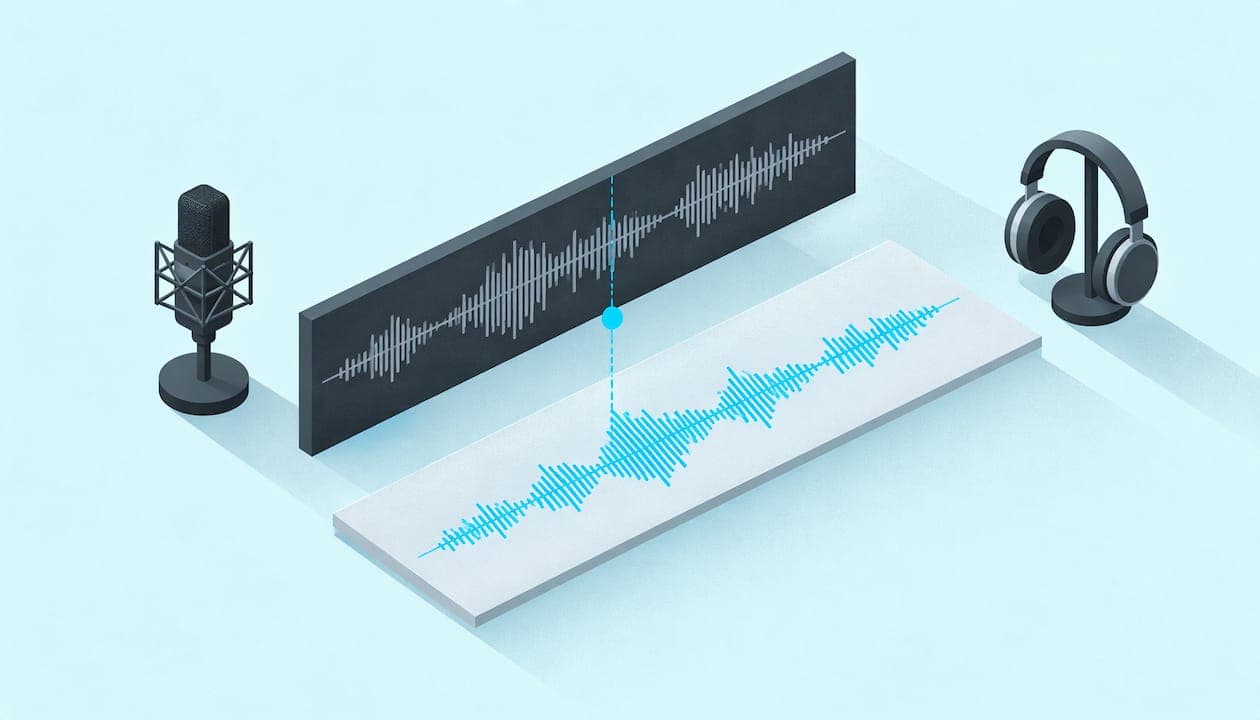
Automated dialogue replacement (ADR) is the process of re-recording dialogue in a studio after filming, so a line that was unclear, noisy or rewritten can be replaced with a clean one. It is a post-production repair and polish tool. If your real goal is to have your video understood by viewers in other languages, ADR is the wrong tool for the job, and dubbing is the right one. Modern AI dubbing, such as DubEnvoy, translates and dubs video into over 50 languages while keeping the speaker’s own voice, tone and emotion, in minutes rather than booth sessions.
This guide explains what ADR is, how a session runs, what makes it sound believable, and how to decide whether you need it, dubbing, or both.
TL;DR
- ADR means re-recording dialogue in a quiet studio, watching the finished picture, to replace unusable production sound or change lines.
- A good session depends on spotting (choosing lines), matching the original microphone and room, and syncing to the picture.
- ADR fixes dialogue in the same language. Dubbing replaces dialogue with a translated version in another language.
- If you are a creator, educator or marketer reaching international viewers, you need translation and dubbing, not a booth.
- DubEnvoy handles translation, voice cloning, lip-sync and subtitles in one workflow, with plans from $4.99 per week.
Table of Contents
- What ADR actually is
- How an ADR session works
- What makes ADR sound real
- ADR vs. location sound vs. dubbing
- Do you need ADR, or do you need dubbing?
- Preparing your video so any re-voicing works better
- When localization becomes a team function
- Voice, consent and the role of actors
- Get your video into new languages
- FAQ
- Sources
What ADR actually is
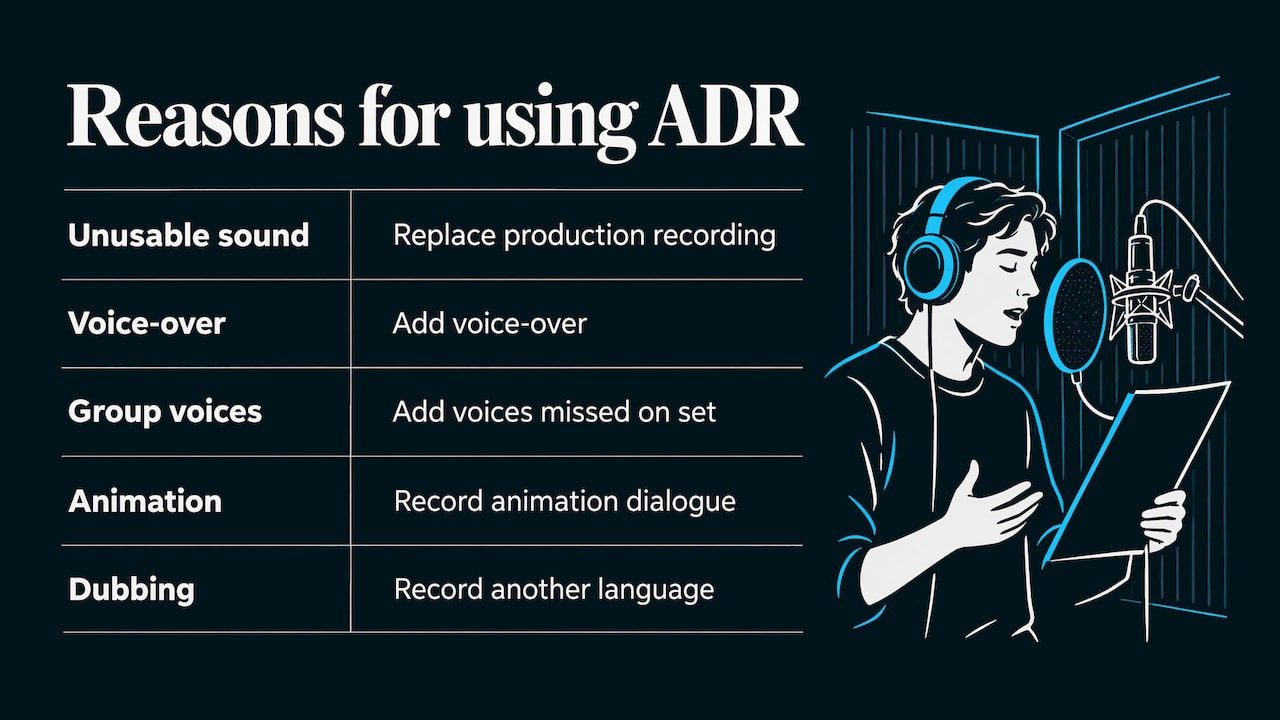
In ADR, an actor (usually the original one) stands in a sound booth, watches the scene on screen, hears the original line in headphones and performs it again in sync with their lips. The new recording replaces the set recording. Mix Online’s primer on dialog replacement lists the reasons it is used: replacing production sound that is unusable for technical or editorial reasons, adding voice-over, adding group voices the set recording did not capture, recording dialogue for animation, and dubbing into another language.
The name varies. You will see “automated dialogue replacement,” “automatic dialogue replacement” and “additional dialogue recording.” Crews often call it looping. All describe the same job. The word “automated” comes from the tools that cue and time the work, not from a machine doing the acting.
Why productions use it
Backstage’s explainer on ADR gives four common reasons, each with a famous example:
- Audio quality. The Lord of the Rings trilogy needed heavy ADR because filming took place near an airport, according to sound recorder Hammond Peek.
- Wide shots. Actors far from the microphone cannot be recorded cleanly, so lines are replaced afterward.
- Story changes. In Blade Runner, a line about “four skinjobs” was added through ADR after the script changed from five replicants.
- Performance. Marlon Brando reportedly preferred ADR to on-set recording, as he told The Godfather’s ADR supervisor Walter Murch.
It is not a requirement of filmmaking. Dialogue and ADR supervisor Rachael Tate puts the ideal this way in the same article: use 100% of the original performance, and record ADR only when you absolutely have to.
The practice is also surprisingly heavy in television. In IndieWire’s craft feature, dialogue editor Sean Heissinger says about 80 percent of what the audience hears in one break-in scene of Barry was captured in ADR. On Poker Face, eight voice actors per episode created background “wild” sound such as casino and barbecue crowds.
How an ADR session works
The workflow has five stages. The names differ between studios, but the order rarely does.
- Spotting. The team watches the locked picture and flags every line to replace. Per LANDR’s overview-style practice, this involves the director, supervising sound editor, dialogue editor and ADR editor. Each flagged line goes on a cue sheet with a number, character, timecode, line text and reason.
- Preparation. The engineer imports the picture and original audio into a digital audio workstation. Avid’s guide to ADR describes marking lines, setting up looped sections and recording several takes into playlists.
- Recording. The actor watches the scene and hears the original track. At USC’s ADR page, the setup is an ADR stage with a control room, where the engineer adds three beeps before each replaced line so the actor knows when to start.
- Editing. The best takes are compiled, silence is stripped, timing is aligned and fades are added. Noise is cleaned up where needed.
- Mixing. The new line gets matching equalization and reverb so it sounds like it was in the scene.
The work is slow when it is badly prepared. Spotting is where time is saved or lost, because a clean cue list is what lets an actor move quickly through a session.
Cueing: how the actor knows when to speak
Three beeps, one second apart, with the line starting on the silent fourth beat, is the classic method. Alternatives include visual streamers, where a line wipes across the picture, and scrolling strips used in French-style dubbing. All do the same thing: they let a performer hit the original mouth movements.
What makes ADR sound real
Bad ADR is easy to hear. Filmmaker Magazine’s guide names four things that sell it: acoustics, proximity, synchronization and performance. Its author argues that the biggest giveaway of bad ADR is sound that does not fit the space, and that performance and space-matching matter more than perfect sync.
- Microphone match. Mix Online reports that ADR mixers learn which microphones the production mixer used and match type, distance and angle, moving the actor or mic as the shot changes.
- Room match. The studio is dry and quiet, so reverb is added afterward. Production Expert’s mixing advice recommends mono reverb to match surrounding dialogue and notes ADR often needs to sit slightly quieter than expected.
- Performance match. The actor has to recreate the energy, breath and projection of the scene. IndieWire quotes co-supervising sound editor Dhyana Carlton-Tims saying her most common note is adding a little movement or breath to the voice.
- Sync. The line must start and stop with the mouth.
USC’s page also notes that ADR is controversial because recreating the on-set environment is hard. That is why experienced crews use production sound first and reserve ADR for lines that truly need it.
ADR vs. location sound vs. dubbing
Three terms get mixed up constantly. This table separates them.
| Location sound | ADR | Dubbing | |
|---|---|---|---|
| When | During filming | After filming, against finished picture | After the finished version exists |
| Language | Original | Original | A different language |
| Script | As shot | Same line, or an edited line | Translated and adapted |
| Purpose | Capture the performance | Repair or change dialogue | Reach a new audience |
| Performer | Original actor | Usually the original actor | A voice actor, or a cloned voice of the original |
A practical guide from VoiceEditSuite puts the difference simply: ADR is re-recording in a studio against finished picture because the set recording is unusable or the line changed, while dubbing is the same discipline in another language with a rewritten script.
That guide also summarizes the three kinds of synchrony that dubbing aims for, drawn from Frederic Chaume’s model: the line starts and stops with the mouth, visible mouth shapes match the sounds, and words match gestures. This is exactly why translated audio laid over an unchanged picture can feel off, and why lip-sync matters.
Do you need ADR, or do you need dubbing?
The people who search for this topic come from two very different places. A film sound team asks how to fix a noisy take. A creator, teacher or marketer usually asks something else: how do I get a video to sound natural to people who do not speak my language?
Use this quick test.
- The words are right but the audio is bad. That is an ADR problem. Re-record in the same language, ideally with the same speaker.
- The audio is fine but the audience cannot understand it. That is a translation and dubbing problem.
- You want both. Clean the source first, then translate.
Traditional dubbing involves translators, adaptors, casting, booth time and a mix. That route fits a feature film. It is hard to justify for a weekly lesson, a product demo or a campaign that needs six language versions by Friday.
Why AI dubbing fits creators, educators and marketers
The thing the audience notices in a dub is the voice. A different actor changes who the speaker feels like. DubEnvoy translates and dubs video and audio into over 50 languages while preserving the speaker’s original voice, tone and emotion. Its workflow also includes lip-sync and subtitle generation, so the three kinds of synchrony described above are handled in the same place rather than in separate tools. To see how it works, read our guides to voice cloning in video dubbing and video translation with lip sync.
Here is how the ADR steps map to a dubbing project.
| ADR stage | In a dubbing project with DubEnvoy |
|---|---|
| Spotting lines | You upload the finished video or audio and choose target languages |
| Recording in a booth | The speaker’s voice, tone and emotion are carried into the new language through voice cloning |
| Syncing to picture | Lip-sync is designed to match the new audio to the speaker’s mouth |
| Delivery | Results arrive in minutes, with subtitles available |
The result matters for the audiences you care about. An educator can offer one lecture series to international students without recasting a teacher. A marketer can localize a campaign video for several markets from a single master. A creator can follow YouTube’s lead: Wikipedia reports that YouTube launched an optional multi-language audio feature in September 2025 after a two-year pilot, so viewers expect to pick a language. Our guide to dubbing YouTube videos walks through that workflow.
Preparing your video so any re-voicing works better
The lessons of ADR carry over to dubbing, because both depend on a clean source and clear timing.
- Record clean audio. Production sound is always the best starting point. Close microphones, quiet rooms and no overlapping speakers give any process the most to work with.
- Lock the edit first. ADR happens after picture lock for a reason: changing the cut afterward breaks sync. Translate the final version.
- Keep one speaker per track where you can. Clear separation of voices helps with voice cloning and with matching each person.
- Watch the result at normal speed. The test of ADR is whether the audience stops noticing it. Do the same with a dub: if viewers are straining to understand, you are losing them, as Filmmaker Magazine’s author says.
- Plan for each market. Check names, product terms and on-screen text. Subtitles can cover the on-screen part.
For audio-only content such as podcasts and courses, our guide to AI audio dubbing covers the same preparation.
When localization becomes a team function
Once localization is a regular part of your publishing, you may build a team around it. Companies planning that kind of growth can look at hiring in media localization, which covers specialist roles in the language services and localization industries. For large volumes, DubEnvoy also offers enterprise access with API integrations and high-volume processing.
Voice, consent and the role of actors
Dubbing and voice work carry professional and legal norms. According to Wikipedia’s summary, the 2023 SAG-AFTRA TV/Theatrical contract allows lip and facial movements to be adjusted to match a foreign language as part of standard dubbing without extra performer consent, as long as human voice actors perform the dubbed audio. If you cast or clone anyone’s voice, make sure you have the right to use it. Cloning your own voice, or the voice of a colleague who has agreed, is the clear case. DubEnvoy describes its workflow as designed with voice and media privacy safeguards.
Get your video into new languages
If your project needs a new language rather than a cleaner take, start with DubEnvoy. The Weekly Dub Plan costs $4.99 per week, the Monthly Dub Plan $19.99 per month, and Monthly Dub Pro $34.99 per month. An Enterprise & High Volume option is available for agencies and broadcasters, with no published price. You can compare them on the pricing page.
Upload your finished video, pick your target languages and get back a dub that sounds like the same person speaking.
FAQ
What does ADR stand for?
ADR stands for automated dialogue replacement, also written automatic dialogue replacement or additional dialogue recording. It describes re-recording dialogue in a studio after filming. The new takes replace lines that were unclear, noisy or changed.
Is ADR the same as dubbing?
Not quite. ADR re-records dialogue in the same language, usually with the original actor, to fix or change a line. Dubbing replaces the dialogue with a translated version in another language, so the audience can follow without reading subtitles.
Do actors re-record their own voices for ADR?
Yes, ideally. Mix Online reports that ADR mixers match the original microphone type, distance and angle so the new line fits the scene. A sound-alike is sometimes used when the original actor is unavailable.
Why does ADR sometimes sound fake?
Usually because the new line does not fit the space or the performance. Filmmaker Magazine’s author says the biggest giveaway is sound that does not match the room. Matching the microphone, adding fitting reverb and recreating the energy of the scene solve most of it.
Can I use AI to dub my video into other languages?
Yes. DubEnvoy translates and dubs video and audio into over 50 languages, preserving the speaker’s voice, tone and emotion, with lip-sync and subtitles. Plans start at $4.99 per week.
Sources
- Dialog Replacement 101, Mix Online
- ADR in Film: What to Know, Backstage
- What Is ADR, IndieWire
- ADR in Film: Recording, Editing, and Mixing Dialogue, Avid
- ADR, John C. Hench Division of Animation + Digital Arts, USC
- Say it Again: How to Do No-Budget ADR, Filmmaker Magazine
- How Re-recording Mixers Get ADR To Sit Well In A Mix, Production Expert
- Dubbing, Wikipedia
- ADR and Dubbing Sessions: A Practical Guide, VoiceEditSuite
- What is ADR in Film, LANDR