AI Audio Dubbing: How It Works and How to Get Good Results
AI audio dubbing replaces the speech in a video or recording with a new track in another language, and it can keep the speaker’s own voice, tone and pacing. For a teacher, a marketer or a creator, that means one recording can reach viewers who would never read subtitles or sit through a language they don’t speak. DubEnvoy is built for this job: we translate and dub video and audio into over 50 languages while preserving the speaker’s voice, tone and emotion, and our workflow is designed to deliver results in minutes.
This guide explains what happens between your original file and the dubbed one, what decides whether the result sounds natural, and the review routine that separates a dub people trust from one they click away from.
TL;DR
- AI dubbing chains speech recognition, translation, voice synthesis and timing alignment, so the new audio fits the original recording.
- Dubbing replaces the audio, subtitles only add text. Viewers can watch and listen without reading.
- Quality depends on clean source audio, a corrected transcript and a native-speaker listen before you publish.
- Get written consent before cloning anyone’s voice, and check the licence of any music in the video.
- DubEnvoy dubs into 50+ languages with voice cloning, lip-sync and subtitles, from $4.99 per week.
Table of Contents
- What AI audio dubbing is, and how it differs from subtitles and voiceover
- How AI dubbing works, step by step
- What affects how natural the dub sounds
- Review before you publish
- Adapting content for the audience, not just the language
- Voice, consent and rights
- Which content suits AI dubbing
- Dubbing with DubEnvoy
- Where AI dubbing is heading
- FAQ
- Sources
What AI audio dubbing is, and how it differs from subtitles and voiceover
There are three common ways to make a video understandable in another language.
- Subtitles add translated text on screen. The original audio stays. Viewers must read while they watch, which is hard for a tutorial where they also need to follow the screen.
- Voiceover lays a translated voice over the original, often with the original audible underneath.
- Dubbing replaces the spoken track entirely so the video plays as if it were made in the target language.
Traditional dubbing means translators, a script adapter, voice actors, a studio and an audio engineer. That is why it was reserved for films and big campaigns. AI dubbing automates the chain, which puts the same idea within reach of a single lecturer or a small marketing team.
How AI dubbing works, step by step
Researchers describe automatic dubbing as speech-to-speech translation with an extra requirement: the output must stay close to the original in timing, rhythm and acoustic feel. An Amazon study presented at the IWSLT conference breaks this into recognition, translation and synthesis, with length-controlled translation, prosodic alignment and audio rendering that restores background noise and reverberation from the original. In practice you can think of four stages.
- Speech recognition. The system turns the spoken audio into timed text. Everything downstream depends on this transcript, so a misheard word here becomes a mistranslated word later.
- Translation. The transcript is translated for spoken delivery, not for reading. Spoken language needs shorter sentences, natural phrasing and idioms that land.
- Voice synthesis. The translated text becomes speech. With voice cloning, the new track keeps the character of the original speaker, so a presenter can “speak” a language they have never learned.
- Timing and lip-sync. The new audio is fitted to the original segments. More advanced systems also adjust the picture so mouth movements match the new speech. A DeepMind report on audio-visual dubbing describes a system that does exactly this: it transcribes, translates, synthesizes speech in the original speaker’s voice and generates matching lip movements.
That same report notes that human editors substantially improve results over fully automated translation. Hold on to that point, because it shapes the review routine below.
What affects how natural the dub sounds
Anyone who has heard a flat, robotic dub knows the difference is real. A few factors account for most of it.
Source audio
Background music, room echo and people talking over each other all make recognition harder. A clean voice track gives the system the best starting point. If you have the voice and music on separate tracks, keep them separate.
Language length
Some languages need more words than English to say the same thing. When the translation runs long, the system has to speed up the voice or trim the line. Shorter, plainer source sentences give the translation room.
Emotion and delivery
A cloned voice captures how a person sounds. Capturing how they feel in each sentence is harder, which is why voice and emotion preservation is the part worth checking first. DubEnvoy is designed to carry the speaker’s voice, tone and emotion into the target language, and a quick listen to the loudest and quietest moments of your video shows you how well it carried.
Camera and speakers
Lip-sync works best on a presenter facing the camera. One analysis of lip-sync output on frontal talking-head footage found consonant articulation matched closely about 78% of the time, falling to 44% with significant head motion or off-center angles. Interviews with several overlapping voices are harder than a single narrator for the same reason.
For a lecture, a product demo or a to-camera announcement, the conditions are favorable. For a panel discussion, plan a little more review time.
Review before you publish
A 2026 University of Malta study by Giselle Spiteri Miggiani evaluated AI dubbing outputs and found that synchronization was the most frequent error, and that human review is what brings output up to professional standards. The study points to synchronization, voice consistency and expressiveness, narrative cohesion, sound design and translation as the areas where a human ear matters most. The takeaway is practical: treat the AI draft as fast, and your review as the finish.
Here is a routine that takes little time and catches most problems.
- Check the transcript first. Fix names, numbers and jargon in the source text before translating. Errors multiply after this point.
- List words that must not change. Brand names, product names and acronyms are where pronunciation most often goes wrong, so decide how they should sound.
- Dub one language first. Listen to the whole thing before you batch the rest.
- Have a native speaker listen, not read. A script can look right and still sound stiff. Ask about tone, pace and anything that feels like a literal translation.
- Check on-screen text separately. Slides, captions and interface labels are not part of the spoken track.
- Publish each version where the audience will find it, on the matching language page or channel.
The approach to reviewing before scaling is the same one marketers use when they are testing AI video ads: check a small version with real people, then expand once it holds up. For high-stakes content such as legal, medical or compliance training, media coverage of dubbing quality points to an expert in the loop as the best tactic. There is also no widely used automatic score for speech-to-speech quality comparable to the ones used for text, so a listening review remains the dependable check.
Adapting content for the audience, not just the language
A correct translation can still be the wrong message. Microsoft’s globalization guidance says dubbing must account for cultural differences such as references, idioms, symbolic meanings and taboos, and must sound like natural dialog in the target language.
What that means for each reader:
- Educators: swap local examples (currency, sports, holidays) for ones students will recognize, and speak a little slower in the source for clearer recognition.
- Businesses: keep a glossary of product and legal terms so the same term is used in every language.
- Creators: a catchphrase or joke may not travel. Decide whether to keep it, translate it or cut it.
- Marketers: check that the call to action, price format and offer make sense in the target market before you spend on distribution.
If you publish on YouTube, our guide to dubbing YouTube videos covers the creator workflow in more detail.
Voice, consent and rights
Cloning a voice is the feature that makes dubbing feel personal, and it comes with a simple rule: use only voices you have permission to use.
- Get written consent from anyone whose voice you clone, and say how long and for what purpose it will be used. Agreement to appear in an English video does not automatically extend to other languages.
- Dubbing does not change the licence of music, stock footage or images in your video. Check that your licence covers the countries where you will publish.
- Rules on synthetic voices are changing. In the US they vary by state, so if you publish commercially or use a voice other than your own, speak with a lawyer about your situation.
Research also shows why transparency helps. A study of voice cloning by Bianchi and colleagues found that cloned voices were rated more authoritative and warm than the originals across 86 speakers, with listeners reporting greater trust. That is a reason to use cloning thoughtfully and tell your audience when a track is AI-dubbed, so the warmth is never mistaken for something it is not.
Which content suits AI dubbing
AI dubbing fits best where speed and reach matter and the delivery is clear.
| Content | Fit | What to check |
|---|---|---|
| Lectures and online courses | Strong | Technical terms, slide text |
| Product demos and explainers | Strong | Brand names, call to action |
| Social and YouTube videos | Strong | Slang, jokes, pacing |
| Training and onboarding | Strong | Glossary, native-speaker review |
| Panels and lively interviews | Workable | Speaker separation, overlap |
| Children’s shows, comedy, music | Needs extra care | Emotion, timing, rights |
Dubbing with DubEnvoy
DubEnvoy is an AI dubbing studio for creators, educators, marketers and businesses. You upload a video or audio file, choose from over 50 languages, and get a dubbed version that preserves the speaker’s voice, tone and emotion. Our tools also cover lip-syncing and subtitle generation, and we offer mobile apps, developer APIs and enterprise integrations for teams that dub at volume. Our workflow is designed to produce localized content in minutes, with voice and media privacy safeguards.
Plans are published on the pricing page: the Weekly Dub Plan is $4.99 per week, the Monthly Dub Plan is $19.99 per month and Monthly Dub Pro is $34.99 per month. Enterprise and high-volume needs are handled through a custom agreement.
If you want to hear your own content in another language, start at DubEnvoy.
Where AI dubbing is heading
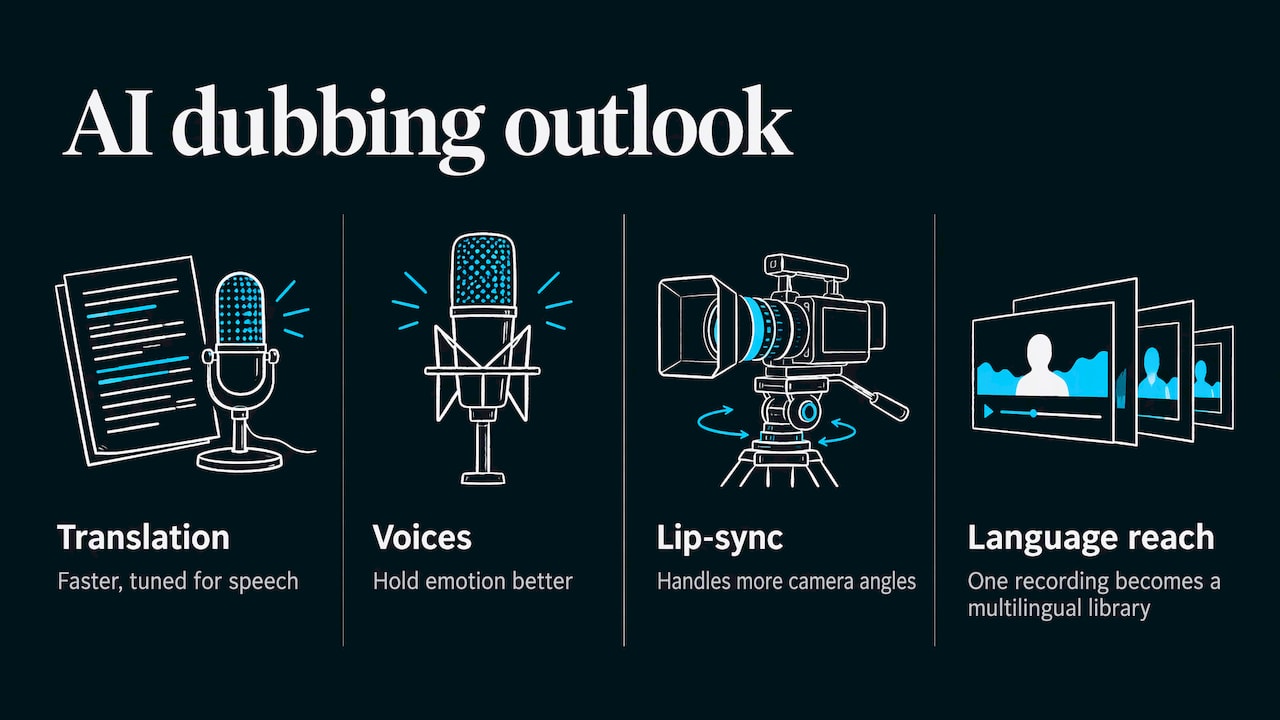
The direction is clear: faster translation tuned for speech, voices that hold emotion better, and lip-sync that copes with more camera angles. The research above shows the gap is narrowing, and human review is what makes the most of it. For anyone who produces video for learners or customers, the practical advantage is that a single recording can now become a library in many languages, with you in charge of the final listen.
FAQ
Is AI audio dubbing the same as text-to-speech?
No. Text-to-speech only reads text aloud. Dubbing starts from your recorded speech, transcribes and translates it, then generates speech in the new language and fits it to the original timing. Voice cloning keeps the speaker’s own voice character.
Do I need lip-sync for every video?
Not always. For voice-only content such as podcasts, lectures with slides or screen recordings, there is no face to match. Lip-sync matters most for a presenter facing the camera, where mismatched mouth movements are noticeable.
How should I check a dub in a language I don’t speak?
Ask a native speaker to listen to the full track without reading the script. They can tell you if it sounds natural, if names are pronounced correctly and if the tone suits your audience. Do this on one language before you produce the rest.
Can I clone someone else’s voice?
Only with their written consent, which should cover how and how long the voice will be used. Laws on synthetic voices differ by state and country, so for commercial projects ask a lawyer.
Sources
- From Speech-to-Speech Translation to Automatic Dubbing (Amazon, IWSLT 2020)
- Large-scale multilingual audio visual dubbing (DeepMind)
- AI Video Dubbing in 2026: What Is Actually Ready for Production (Increditors)
- How to Assess AI Dubbing Quality (Slator)
- Re-creation and dubbing, Globalization (Microsoft Learn)
- Voice “Cloning” is Style Transfer (Bianchi et al.)
- AI Video Ads: How to Make, Test and Scale Them