Amharic to English Voice Translation for Video and Audio
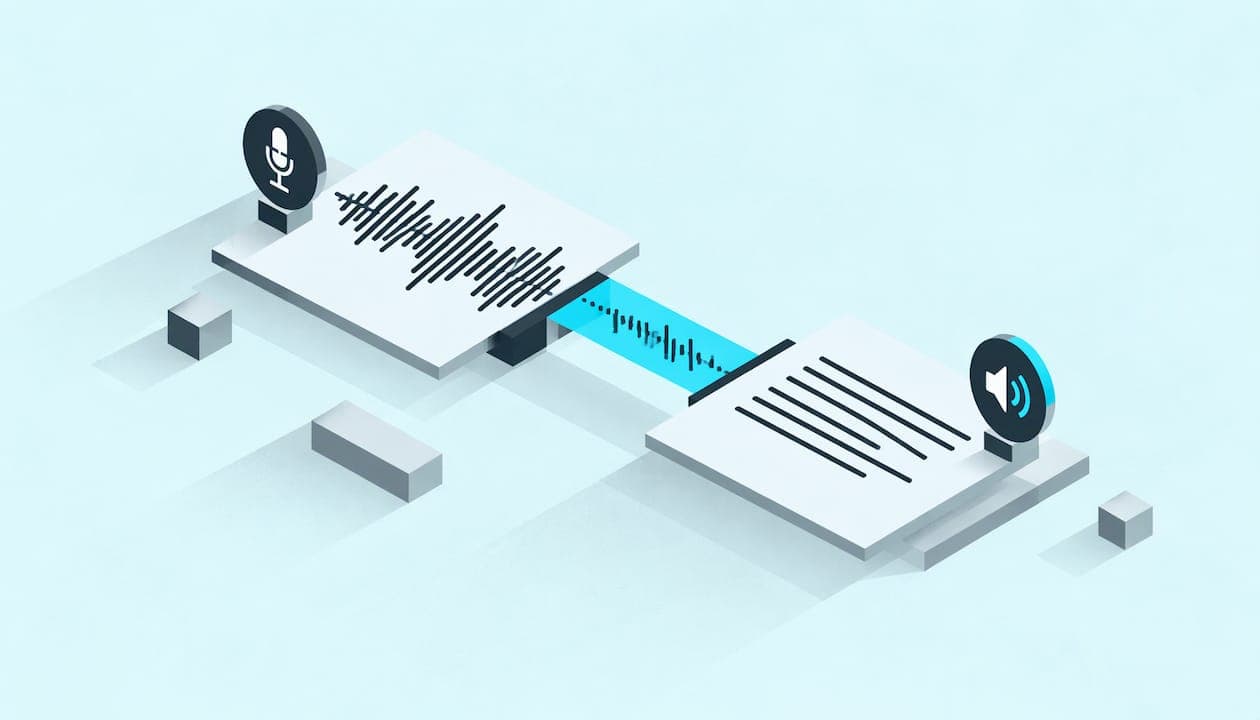
Amharic to English voice translation takes spoken Amharic and returns spoken English, usually with a written transcript. For a teacher, a business, a creator or a marketer, the best result is not a one-off phrase translator. It is a finished English version of your recording that sounds like the same person, keeps the pacing of the original and arrives with subtitles. That is the workflow our studio, DubEnvoy, is built around: you upload a video or audio file, and the translated, dubbed version comes back in minutes, with the speaker’s voice, tone and emotion preserved.
This guide explains how the technology works, what decides the quality of the English you get, and how to prepare, check and publish a translated recording.
TL;DR
- Voice translation chains three steps: speech recognition (Amharic audio to Amharic text), translation (text to English) and English speech generation. Quality at each step shapes the final result.
- Clean audio, one speaker at a time and a reviewed transcript matter more than anything else you control.
- For content you publish, such as lessons, product videos or campaigns, a dubbing workflow with voice cloning, lip-sync and subtitles beats a phrase-by-phrase translator.
- DubEnvoy translates and dubs video and audio into over 50 languages. Plans start at $4.99 per week.
- Always have a person who knows the subject read the English transcript before you publish.
Table of Contents
- What Amharic to English voice translation actually does
- Why Amharic needs more care than a major European language
- What affects the quality of your English output
- Three ways people translate spoken Amharic
- How to translate Amharic audio or video into English, step by step
- What this means for each audience
- Privacy and safe sharing
- Dub your Amharic content with DubEnvoy
- A simple quality checklist before you publish
- FAQ
- Sources
What Amharic to English voice translation actually does
Amharic is the working language of the Ethiopian federal government and is written in its own script, Ge’ez (also called Fidel). Voice translation has to deal with both the sound of the language and the way it is written, because the first step turns audio into text.
The pipeline has three stages:
- Speech recognition (ASR). Automatic speech recognition listens to the Amharic audio and writes down what was said. This is transcription, and it stays in Amharic.
- Machine translation. The Amharic transcript is converted into English text. This is where meaning, idiom and word order change.
- Speech synthesis. The English text is spoken aloud by a generated voice. In a dubbing studio, that voice can be cloned from the original speaker so the English version still sounds like them.
This is why “transcription,” “text translation” and “voice translation” are not the same product. Transcription gives you Amharic words. Text translation gives you English words. Voice translation gives you English audio you can play for an audience, and the best workflows also hand you the transcript and subtitles so you can check what was said.
Some newer systems skip the middle step and translate speech directly. A 2026 benchmark presented at EACL found that speech-native models, especially Gemini and SeamlessM4T, scored higher than separate recognition-plus-translation pipelines on audio-to-English translation for low-resource African languages. Whichever design sits under the hood, your job is the same: give it good audio and review what comes out.
Why Amharic needs more care than a major European language
Amharic is spoken by tens of millions of people, but it has far less training data online than Spanish or French. A 2025 systematic review in Frontiers in Artificial Intelligence traces Amharic-English translation from statistical methods to neural and transformer models and notes that progress is still shaped by limited parallel text, difficult tokenization and Amharic’s complex morphology. Morphology means that one Amharic word can carry what English spreads over several words: a verb can include the subject, object and tense in a single form.
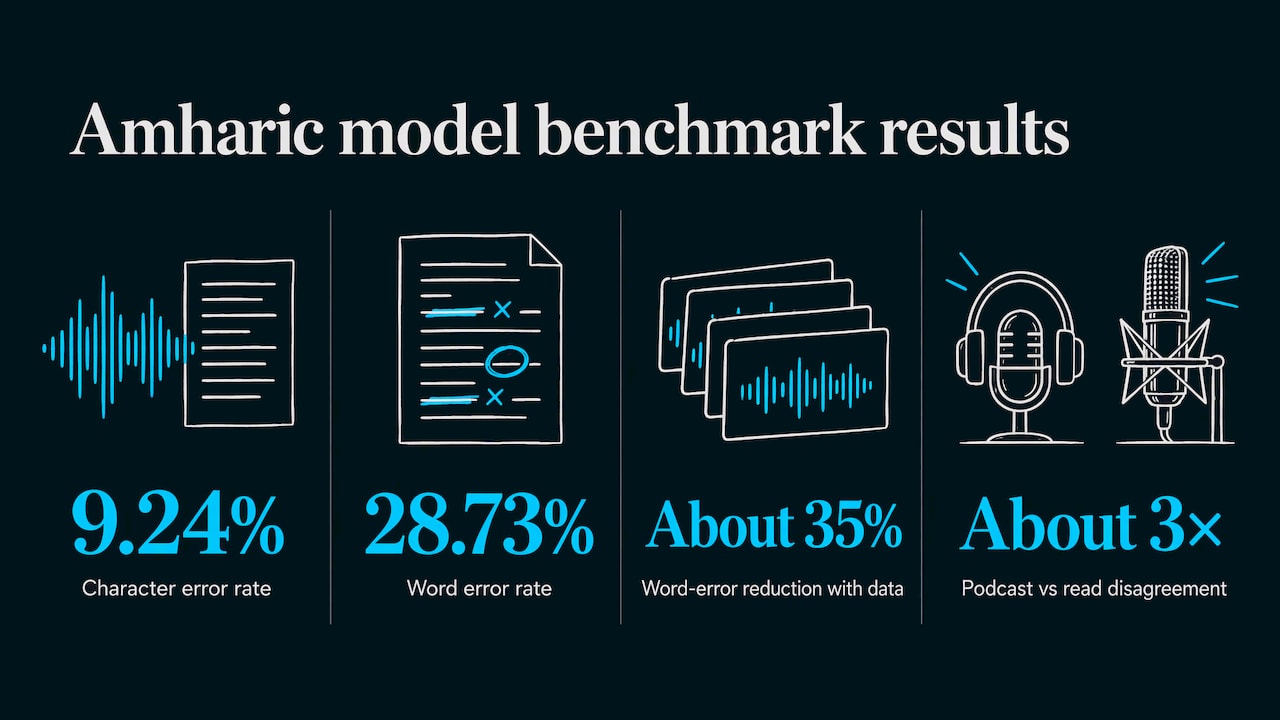
The practical consequence is that results depend on the input. A 2026 benchmark of 16 Amharic speech models on 1,548 clips reported that the best open model reached a 9.24% character error rate and a 28.73% word error rate, and that a model trained on additional Amharic data cut word errors by about 35% relative. The authors attribute that gain to data rather than architecture. In other words, the field is improving quickly as more Amharic speech is collected, and the quality you get keeps rising with it.
A separate benchmark from Dataset.ET, an Ethiopian data team, found that recognition numbers on read sentences are best-case figures, and that models disagree about three times as much on real podcast audio. That tells you where to put your effort: real recordings with several voices, music and room noise are harder than a clean studio read. You can prepare for that.
What affects the quality of your English output
You cannot rewrite the models, but you control most of what they hear. These factors matter in roughly this order.
Audio quality
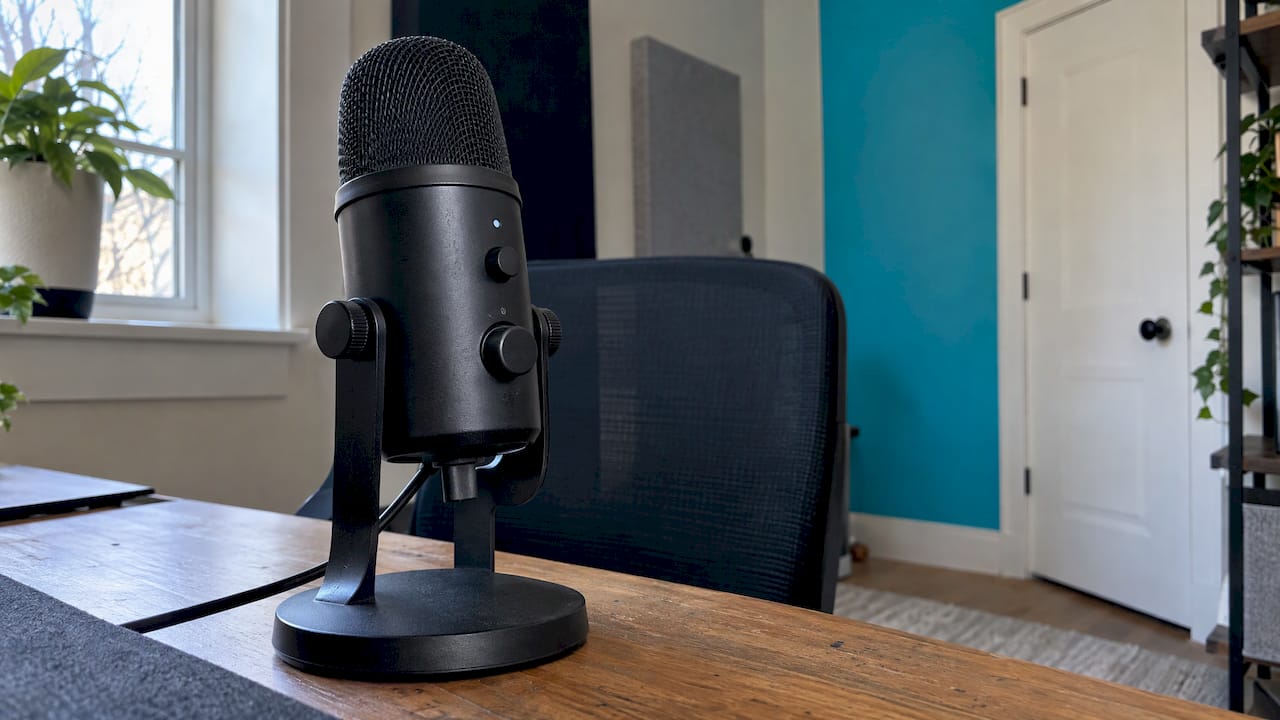
Background music, echo, traffic and compressed phone recordings all blur the sounds the recognizer relies on. If you have the original recording rather than a screen capture or a re-uploaded social clip, use that. If you are recording new material, a USB microphone placed close to the speaker in a quiet room does more for accuracy than any setting later.
One speaker at a time
Overlapping speech is hard for people and harder for software. In a panel or interview, ask speakers to finish before the next one starts. Separate tracks per speaker, when you have them, are better still.
Dialect, accent and register
Amharic spoken in Addis Ababa differs from regional speech, and formal broadcast Amharic differs from casual conversation. Code-switching, where a speaker moves between Amharic and English words mid-sentence, is common in business and education. Make a note of it in advance so you know which passages to review most carefully.
Names, numbers and terminology
Personal names, place names, brand names, course titles and technical terms are where translations most often slip. Keep a short glossary: the Amharic term, the English term you want and a one-line note. Check these first in the transcript.
Length and context
The AfriVox researchers observed that speech-native models gain the most on longer, context-rich utterances, while unscripted, spontaneous speech remains a robustness challenge. A scripted lesson or a prepared product demo will usually translate more cleanly than an off-the-cuff conversation, so if you can script or outline your recording, do.
Three ways people translate spoken Amharic
The keyword covers different needs, so it helps to separate them.
| Need | What fits | Result |
|---|---|---|
| A live exchange with one person | A conversation-style voice app | Short spoken replies, no polished file |
| A recording you only need to understand | Transcription plus text translation | An English transcript for your own reading |
| Content you will publish for an audience | A dubbing studio | English audio in a voice that matches the speaker, plus subtitles |
The first two solve a personal problem. The third is the one educators, businesses, creators and marketers are usually facing, because the audience will judge the result by how it sounds and reads, and the same file may need to be reused across a course platform, a website and social channels.
How to translate Amharic audio or video into English, step by step
Here is a routine that works whether you are localizing a lecture, a webinar, a product walkthrough or a podcast episode.
1. Start from the best source file
Export the original video or audio, not a downloaded copy from a social platform. Trim long silences and any intro music that is not part of the message. If the music is baked into the same track as the voice, find the version without it if you can.
2. Prepare a glossary and a style note
List names, titles and terms with their English equivalents. Decide the tone: a university lecture should read differently from a TikTok ad. This takes ten minutes and prevents the most visible mistakes.
3. Upload and choose English as the target
In DubEnvoy, you upload the video or audio, choose the target language and the studio produces the translation and the dub. Our workflow is designed to preserve the speaker’s original voice, tone and emotion, so the English version sounds like the same person rather than a generic narrator.
4. Read the English transcript against the Amharic
This is the step that protects your reputation. Have someone who reads Amharic, and ideally knows the subject, read the English transcript while listening to the original. Look for:
- Names and numbers that changed
- Terms translated literally when they have an established English equivalent
- Sentences where an idiom was rendered word for word
- Honorifics and politeness levels that should shift tone in English
Fix the transcript, not just the audio. Corrections made in text carry through to the spoken version and the subtitles.
5. Listen to the dub at normal speed
English often takes a different number of syllables than Amharic for the same idea. Listen for pacing: does a sentence sound rushed, or does the voice finish well before the speaker’s mouth stops moving? For video, lip-sync adjusts the timing of the dubbed speech to the speaker’s mouth, which makes the result easier to watch for long stretches.
6. Add subtitles
Many viewers watch without sound or in a noisy place, and international students often read along to catch unfamiliar vocabulary. Subtitle generation produces an English caption track you can export with the video. Keep captions short and check line breaks on a phone screen.
7. Publish and note the version
Name the file with the language and date, and keep the Amharic master alongside it. When you update the original, you will want to regenerate the English version from the same source.
What this means for each audience
Educators
A lecture in Amharic can reach students who study in English without re-recording it. Prioritize clarity: subject terms in the glossary, a reviewed transcript and subtitles so students can pause and look up words. Short modules of five to ten minutes are easier to review than a two-hour recording.
Businesses entering new markets
Training videos, onboarding content and product demos translate well because the vocabulary is stable. Review anything with pricing, legal terms or safety instructions with a subject-matter reader before it goes out. Keep one approved English glossary for the whole company so each new video stays consistent.
Creators
If your audience grows in Amharic and you want to reach English-speaking viewers, a dubbed version in your own voice keeps your personality in front of the new audience. Dub your strongest, evergreen videos first, then compare watch time against the original.
Marketers
Campaign copy is full of wordplay and cultural reference. Translate the message, not the words: after the dub, read the English as a copywriter would and adjust the script of the original where a line does not travel. Run the localized spot with its own tracking link so you can see how it performs.
Privacy and safe sharing
Before you upload, ask what the recording contains. Student voices, customer calls and internal meetings carry personal information, and you should have consent from the people speaking. Remove anything confidential that does not need to be translated. DubEnvoy’s workflow is built with voice and media privacy safeguards, so your uploaded files and cloned voices are treated with care. Within your own team, limit who can download the finished files and keep the Amharic master in a restricted folder.
For high-stakes content, such as medical, legal or immigration guidance, do not rely on automated output alone. Have a qualified human interpreter or translator review it. A 2026 peer-reviewed study of voice translation in clinical settings concluded that qualified in-person interpreters remain essential for safe clinical communication, and the same care applies to legal and health information you publish.
Dub your Amharic content with DubEnvoy
DubEnvoy is an AI video dubbing and translation studio. It translates and dubs video and audio into over 50 languages, preserves the speaker’s voice, tone and emotion, and includes voice cloning, lip-sync and subtitle generation, so one upload gives you the English audio, the on-screen timing and the caption track. We also offer a dubbing studio, mobile apps, developer APIs and enterprise integrations for teams with higher volume.
Plans are listed on the DubEnvoy pricing page: the Weekly Dub Plan is $4.99 per week, the Monthly Dub Plan is $19.99 per month and the Monthly Dub Pro is $34.99 per month. Agencies, broadcasters and teams with heavy volume can ask about Enterprise & High Volume, which is priced individually. You can see how the studio works on the DubEnvoy homepage.
A simple quality checklist before you publish
- The English transcript was read by someone who understands the Amharic original.
- Names, numbers, dates and prices match the source.
- Key terms follow your glossary.
- The dub’s pacing sounds natural at normal speed.
- Subtitles are short enough to read on a phone.
- Everyone who speaks in the file has agreed to its use.
- The Amharic master and the English version are stored together with clear names.
Over time, the review gets faster. Your glossary grows, you learn which speakers and topics need a second look, and the corrections you make on one video save work on the next.
FAQ
Can I get both an English transcript and spoken English audio?
Yes, that is the normal output of a dubbing workflow. The studio produces the English dub and the subtitles, and the English text lets you check the translation against the Amharic before you publish. Reading the transcript is the quickest way to catch a wrong name or number.
How accurate is Amharic to English voice translation?
It depends mostly on your audio and your content. Published benchmarks show that recognition of Amharic is improving as more training data is added, and that clean, single-speaker audio does best. Scripted material with consistent terminology translates more reliably than spontaneous conversation, so prepare a glossary and review the transcript.
How long does it take to translate a video from Amharic to English?
DubEnvoy is designed to deliver localized content in minutes rather than the days or weeks traditional dubbing takes. Your own review time depends on the length of the video and how much specialist vocabulary it contains.
Will the English version sound like the original speaker?
That is the aim of voice cloning. Our studio is designed to preserve the speaker’s voice, tone and emotion in the translated audio, so students, customers and followers hear a familiar voice in English. A clear, close-microphone recording gives the cloning the most to work with.
Is it safe to upload recordings with personal information?
Get consent from the speakers first and remove anything confidential that does not need translating. DubEnvoy’s workflow includes voice and media privacy safeguards. For medical or legal content, have a qualified professional review the English before sharing it.
Sources
- AfriVox: Probing Multilingual and Accent Robustness of Speech LLMs (EACL 2026)
- Exploring the evolution and future prospects of Amharic to English machine translation (Frontiers in Artificial Intelligence, 2025)
- snapwre Amharic ASR benchmark (Hugging Face)
- We tested every open Amharic speech model (Dataset.ET)
- Google Translate Voice App vs. Qualified Interpreters (PMC, 2026)